For nearly two years, I proudly wore the badge. Every forum profile, dotfiles repo, and terminal neofetch screamed it:I use Arch btw.
There is an undeniable rush to installing Arch. You bootstrap from a raw tty, partition NVMe sectors by hand, assemble your own Hyprland compositor, configure Waybar, and feel like you have ascended beyond mortal operating systems.
Then real work enters the chat. Between an absurdly tiny 30GB partition, the rolling-release tax, and the brutal reality of building React Native apps, my elite Linux setup collapsed under its own weight. Here is the full story of where I LARPed, where that LARP failed, and why my desktop looks identical today on Fedora.
Where I Was LARPing
Let’s be brutally honest: half of using Arch is LARPing as a minimalist Unix purist.
I was LARPing hard on r/unixporn. I spent hours tweaking Hyprland window gaps, animating opacity transitions, and aligning my Waybar modules down to the pixel. I told myself:“Real engineers don’t need desktop environments. I only need a shell, Neovim, and 30GB of disk space. Bloat is for the weak.”
Where the LARP Failed: The React Native Reality Check
The fantasy worked until I started building mobile applications.
As a React Native developer, you cannot be a minimalist. The mobile tooling ecosystem is a resource-devouring behemoth that laughs at your delicate 30GB partition:
- Android Studio & SDKs: Platform tools, system images, emulator AVDs, and NDK toolchains consume 20GB+ in
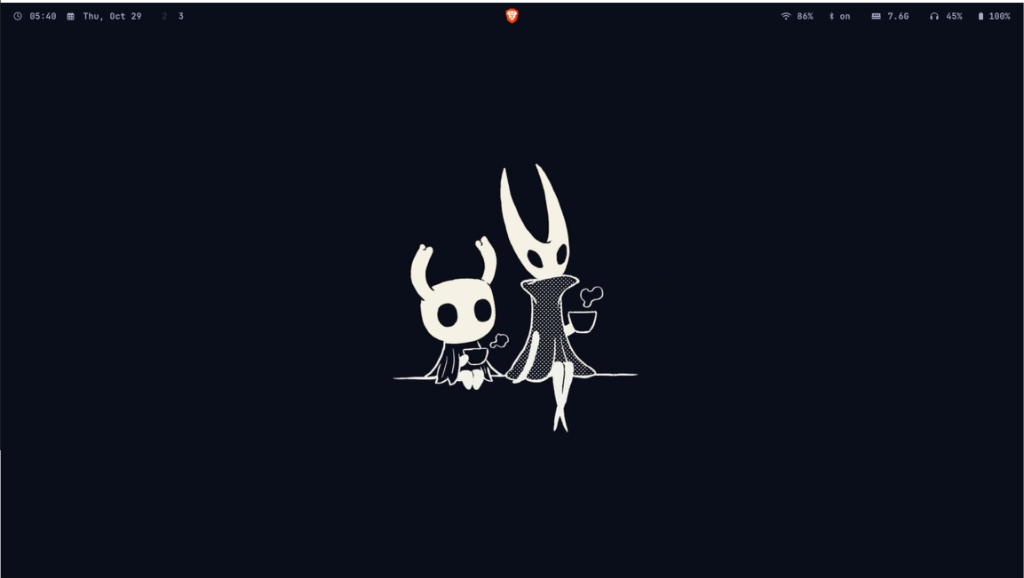
~/Android/Sdkalone. - Gradle Daemons & RAM: Look at the status bar in my screenshot above — 7.6GB of RAM in active use. A single Gradle build daemon routinely eats 3GB to 4GB of memory while compiling native C++ bindings and Java bytecode.
- Metro Bundler & Node: Multiple client projects running concurrently means tens of thousands of nested files in
node_modules. - The Gradle Cache Bomb:
~/.gradle/cachesswells by gigabytes every week.
Now, take that monstrous dev stack and squeeze it onto a dual-boot machine where Windows took 480GB for games, and Arch was crammed into a pathetic 30GB root partition.
Here is the dirty secret of Arch: Pacman has zero default retention limits.Every package you install stays forever in /var/cache/pacman/pkg. Half of my entire 30GB partition was old .pkg.tar.zst files!
Combine that with React Native Gradle builds, and disk space hit 100% on a regular basis. One afternoon, a pacman upgrade ran out of disk space mid-transaction. Half the packages wrote, half corrupted. The display server died on reboot. I had to mount via an Arch USB in a rescue shell just to delete cached packages so my OS could turn on.
The Rolling-Release Pain in the Ass
Disk space was fixable with partition re-sizing. What wasn't fixable was the rolling-release headache.
When you're building software with deadlines, rolling releases are a landmine. You sit down at 9:00 AM on a Friday, run pacman -Syu out of reflex, and suddenly:
- A minor OpenSSL or glibc bump breaks the Android NDK CMake toolchain.
- A PipeWire update kills your mic right before a team call.
- An AUR helper breaks because pacman bumped an internal ABI.
Instead of shipping code, you're reading Arch Wiki forums, debugging shared library conflicts, and rolling back packages. The OS was demanding 30% of my mental energy just to keep itself alive. It was a massive pain in the ass.
The Solution: Fedora Barebone (The Stealth LARP)
I didn't want standard Fedora Workstation with bloated GNOME, Adwaita shell, and background telemetry. I loved the feel of Arch. I loved Hyprland. I loved my keybindings. I loved my Hollow Knight wallpaper.
So I didn't abandon the aesthetic — I just swapped the engine:
- Fedora Everything (Netinstall): Installed the absolute bare minimal base system with zero GUI packages.
- Copied My Old Arch Dotfiles: Brought over my exact
~/.config/hyprand~/.config/waybarconfigs without altering a single keybinding. - Proper Disk Allocation: Carved out 160GB for Linux this time. With Fedora’s default Btrfs transparent compression (zstd), node_modules and Android SDKs take 30% less space on disk.
- Zero Rolling Heart Attacks: Point releases mean package versions stay rock-solid for 6 months. I update when I choose, and my React Native toolchain never breaks unexpectedly.
“I still LARP as an Arch ricer on the surface — but under the hood, Fedora does the heavy lifting so I can actually build things.”
The Verdict
If your goal is learning how Linux works from the inside out, install Arch. It will teach you more about operating systems than any college curriculum.
But when you are building real mobile apps, running Gradle daemons, and shipping software on deadlines, you don’t need an OS that requires daily babysitting. Barebone Fedora gives you the speed, control, and beauty of a custom Hyprland rice — with the stability of a rock-solid foundation.